For the whole year, No impact tried a project to waste as little energy as possible to live. This included no toilet paper,light, eating all things natural and more. He became famous for this reason and received a lot of criticism.
His behavior is very laid-back. Although he is laid back, he is driven toward his goal. He doesn't give up and continued no matter what anybody says. He feels like he can change the world. But the way he went through it, just wasn't enough.
I felt glad, but at the same time i felt that he was trying to hard. He took very drastic measures. He should have started with very reasonable and easy things. He gave up WAY too many things. Everything was for a good cause, but for me, they are needed for me to live. I felt although he was helping the world, he might of been hurting himself a bit too.
Tuesday, June 7, 2011

Wednesday, June 1, 2011
Post 9: This Week in Science (Fruit Flies Part 2)
This week in science we put three fruit flies in our habitat. We also made a poster to show how the fruit flies develop. We showed that they will continue increasing in numbers because we picked a good amount of flies for the experiment. We picked 2 females and 1 male. we put them inside a jar and we will see how they progress.
 We learned a lot of things too. We learned that females produce 20 eggs a day. They also have a cool ability store sperm from the males. So the males only need to reproduce with the females once. They also have an extremely short life span. it takes one day for the eggs to hatch, 7 days to turn into a pupa, 6 days to become an adult, and 2 days to fully mature. All together, we learned a lot this week in science class.

Friday, May 13, 2011
This Week in Science (Fruit Fly DYO Part 1)
This week in science we did a lot of work. We switched all the tables into 3 stations. Then we went to each station doing different things. We observed our spider and fruit flies. We also checked on our habitat and on our flies. We started a DYO based on our flies. We made a table in our book to record things about our multiplying flies.
We learned a lot of things too. We learned about different types of graphs. We learned that line graphs are for changing and bar graphs are for comparing things. We learned how to make a hypothesis. We also learned about variables and how to involve it in our hypothesis. We learned more about flies too by doing background research.
 \
We learned a lot of things too. We learned about different types of graphs. We learned that line graphs are for changing and bar graphs are for comparing things. We learned how to make a hypothesis. We also learned about variables and how to involve it in our hypothesis. We learned more about flies too by doing background research.

Monday, May 9, 2011
Post 8: This Week in Science (Fruit Flies Part 1)
 This week in science was cool. We received the flies that we ordered and put the teachers put them into tubes. We then studied our habitats again and we studied the flies. We first studied the flies with a glass magnifier. We also received a paper showing all kinds of body parts of a fly. After studying and drawing the flies, we took a closer look at it with a Microscope.
We learned a lot about the flies too. We learned about male flies and female flies. Females flies are actually bigger than male flies. male flies also have a darker bottom. The female stores the males sperm and then makes babies. the egg hatches in a day, turns into a larva, becomes a pupa for 6 days, and then becomes an adult. We learned so much about little flies. this is what we learned this week in science.
This Week in Science (Ecosystems)
 | |
| My team, putting in organisms in our habitat |
This week in science we explored our habitat and saw all the changes within it. Our moss grew, our worms disappeared, and more. We figured out what type of kingdom our animal belonged in, and color coded it.We also researched and created an accurate illustration of our habitat. I learned alot about moss. They are non-vascular plants that absorb water and nutrients through their leaves.
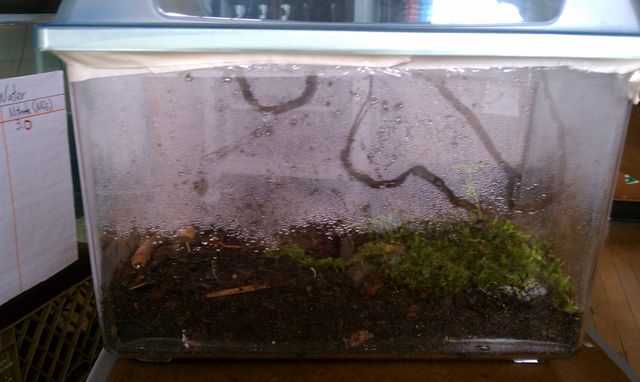 | |||
| Our humid habitat |
Sunday, April 10, 2011
This week in Science: Carrying Capacity

We learned about predator/prey relationship. We also learned about mutualism. We watched videos of how all of this works. We learned about carry capacity too. The it works is that, if an animal reproduces too much, then there may not be enough resources to do around. Or, if the certain resource that an animal needs isn't available, then the animal that needed that resource dies.
Friday, April 1, 2011
This week in Science -Spider Habitat Design-
This week in science i made a habitat for a spider. We also learned a lot about spiders. We learned what type of environments they live in. We learned a lot from the Carbon Cycle game. We also learned a lot from our group partners.
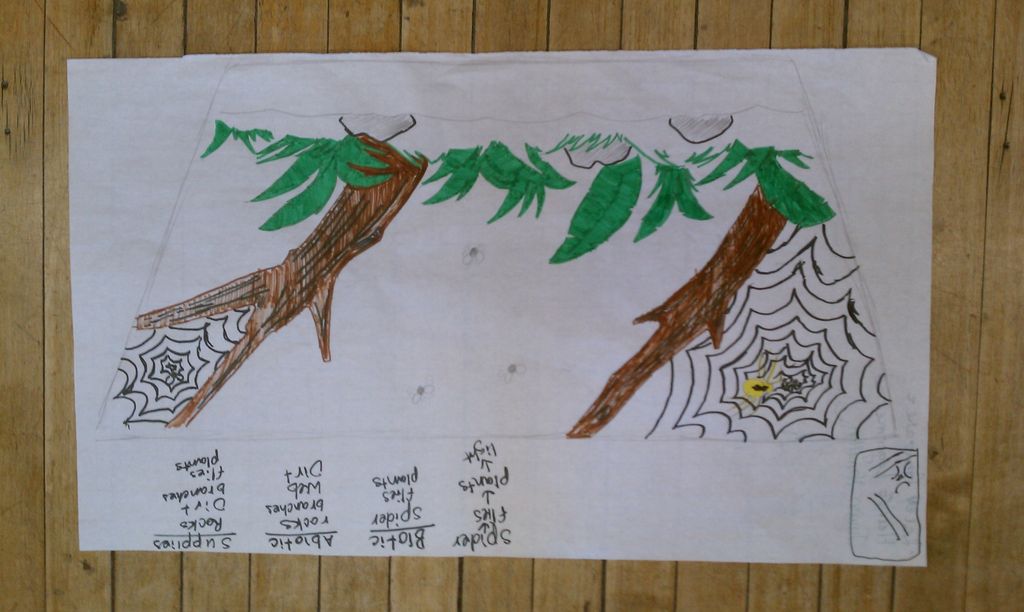
 Later on we made a giant habitat displaying how out spider will live. we put in branches, dirt, and bugs for it eat. We put in limiting factors, a food chain and more. We also colored it to make it look good. all our group members helped make it a wonderful poster.
In our picture, we have a lot of scientific stuff. In our food chain the sun sun always starts off everything. It then has grass, which are the producers, then little insects which are consumers. the flies are the secondary consumers, and the main predator, the spider, is the tritary consumer. This goes for the energy pyramid too. The energy converts from the plants, to the insects, to the spider. Without another spider, the spider's capacity cannot increase.
In our picture, we have a lot of scientific stuff. In our food chain the sun sun always starts off everything. It then has grass, which are the producers, then little insects which are consumers. the flies are the secondary consumers, and the main predator, the spider, is the tritary consumer. This goes for the energy pyramid too. The energy converts from the plants, to the insects, to the spider. Without another spider, the spider's capacity cannot increase.
Subscribe to:
Posts (Atom)